What are the Chances?

What are the Chances?

I’m not a gambler, but it does feel like I’m always calculating the odds. Is it going to rain this week? Will the Adelaide Crows win? What’s the chance of a quiet evening without the phone ringing? We all peer into the future, Christians perhaps more than most. Which way is society going? To hell in a handbasket, or coming home to God?

Well, here’s some good news. A report issued last month by McCrindle1 showed that while nominal Christianity has dropped significantly over the last few censuses, some remarkable things have been happening regarding practicing Christianity:

  • The percentage of Australians attending church at least monthly has steadily risen from 15% (in 2011) to 21% (in 2021).
  • The percentage of Australians who are warm towards Christianity has risen from 58% in 2011 to 65% this year.
  • No less than 784,000 Australians who ticked ‘No Religion’ in the 2016 census went on to tick ‘Christian’ in the 2021 census. Think about that!
  • The percentage of Australians who are open to changing their religious views has risen from 8% in 2011 to 19% this year. (This looks like a shift from ‘these things are set in cultural stone’ back towards a genuine contest of ideas.)

McCrindle notes that across the 2010s it was older Australians driving the growth in Christianity. Other studies2 are now showing a surge this decade by younger people. What a turning of the tide! Let me make 3 comments:

  1. Praise the Lord! He is so good, why should we be surprised that more and more people turn to him?
  2. Much gospel work is a matter of sowing and reaping. I’d like to pat on the back all the sacred agents who represented Jesus well when the wind was against them, when following Jesus was uncool. To all the church leaders who’ve worked so hard at child safety and other standards, and to a million anonymous Christians who’ve been quietly washing feet, serving the marginalised, raising kids to know Jesus or praying for Grandkids. Others will reap what you’ve sowed, but you won’t go unrewarded.
  3. And when it comes to the Chances – what all this means for your local church or small group or ministry: For all this good news, the biggest factor determining growth is not societal trends, but the extent to which you invite, welcome and include. The likelihood of someone accepting an invitation to church may have risen from 30% to 40%, but 40% of zero is the same as 30% of zero.

Invite, invite! Make hay while the sun shines. And not just your ‘interested’ friends but everyone the Lord loves.

1 ‘An Undercurrent of Faith’ – McCrindle, 2025 – full report
2 See NCLS “Young People Most Frequent Attenders at Religious Services” here and the surge in Gen Z attendance in the UK

Author: Andrew Turner is the Director of Crossover for Australian Baptist Ministries.

Photo by Rhio Kroll on Unsplash

Church Growth as a Service

Church Growth as a Service

It’s hard to talk about church growth, but we need to – particularly in this moment of quiet revival*. We know God wants more people to be reconciled to Him. Yet pursuing growth can feel tainted by (or like flirting with) pride, manipulation, social engineering, and a predatory attitude toward people. None of that smells like Jesus, so conversations about growth often stall in awkward ambivalence.

And yet… we sacred agents remain convicted: God wants more people reconciled to Him. We’re commissioned to make disciples, and disciples are formed in community. So how do we move forward, when it feels Christian to both want growth and not want it?

The language of family makes a helpful start. In God’s extended family, our local churches are like little households. And in his mercy, he longs for more siblings to be adopted in. To those who receive Jesus and believe in His name, God gives the right to become His children. And a new place is needed at the table for each new child.

This is where churches can set tangible goals that align with God’s kingdom—without coercion, trickery, or sales targets. We can’t make people come to Christ, but we can remove barriers and make space for them.

What if a church of 50 didn’t aim to become 100 just for the sake of numbers, but instead worked to prepare places for 50 more? What if it offered that as a prayer-in-action: by buying more chairs, communion glasses, coffee cups; by preparing to run Alpha; by building a baptism pathway; by planning a sermon series accessible to newcomers; by auditing the liturgy for unintentional exclusivity; by planning ministries for generations not yet present—even building a playground when the youngest member is 57?

Some of this may stretch a church’s current capacity—but plan anyway, and pray specifically. Not just “God, send young families,” but “God, help us become the kind of church that’s fully ready to welcome and include young families.”

It’s a noble thing to prepare to feed more mouths and shelter more orphans. When a church gets this in its heart, it both lays a dare before God and also becomes confident to warmly invite others, without pressure. Here’s a great discussion-starter: “If God hand-delivered seekers and new believers to us tomorrow, how many could we take in and nurture? And what’s stopping that number from being higher?”

*Here’s a summary of a report from Bible Society UK showing soaring church attendance there – a trend also increasingly evident in Australia. It doesn’t affect all churches. It does disproportionately affect churches that are ready.


Author: Andrew Turner is the Director of Crossover for Australian Baptist Ministries.

Photo by Siya Nzimande on Unsplash

Becoming a Gospel Prepper

Becoming a Gospel Prepper

The Good Samaritan must have had some margin in life, don’t you think? Loving your enemy-neighbour that much surely took quite some admin! Bothering to attend to the battered stranger in the first place. Then there was all the over-and-above: Time taken to get him to care, money spent for treatment and recouperation, forty bucks for the deluxe donkey-wash.

Who has the time and money ready for that sort of spontaneous act? Uncomfortably, my first answer is ‘Not me’, and my second answer is, ‘The person who loves their neighbour the Jesus way.’ So going forward as a sacred agent, I have adjustments to make.

I think preparation is the key. Careful preparation opens up windows for spontaneity, as any romantic will tell you. So what would it look like to be a gospel prepper?

‘Preppers’, of course, are people who stockpile supplies in case of a future disaster. Sacred agents similarly have an eye on the future. We’re not oblivious to the dark powers and spiritual forces in the world, so putting on the armour of God Eph6 is good preparation for standing firm. But part of that armour, in Paul’s metaphor, is “feet fitted with the readiness that comes from the gospel of peace.” So standing firm does not mean standing back or standing still!

Are we fitted out to cross that road and help that bleeding stranger? To run up to that chariot and share with the Ethiopian official? Ac8 To make the most of every opportunity with gracious conversation? Col4 The peace we have with God means we prepare not out of a sense of doom or lack of control in this crazy world – but with all the assurance of the one who naps in the boat before calming the storm.Mt8 The peace we have with God is a shalom we can share in radical ways like the Samaritan. It shows and tells the good news that what’s upon us – and right up in our face – is not a zombie apocalypse, but the kingdom of God.

Here’s a very basic Gospel Prepper’s Checklist:

  • TIME: You can’t schedule sudden opportunities. But why not arrange a code-word you can say/text to your friends/family that means, ‘Sorry, I’m delayed by an opportunity to show and share Christ’? Just having that conversation in advance could be helpful all round.
  • MONEY: A gospel-opportunity fund – even if it’s only enough to buy someone a meal – it’s set aside and ready to go when the opportunity comes.
  • WORDS: Memorise a basic outline of your own testimony/gospel outline, cleared of jargon and tangents and practised on your Christian friends – so you really are ‘always prepared to give an answer’ when asked about your hope.1Pe3

Imagine how effective we’d be at sharing Jesus if we were prepped up like that? How prepared are you? And what would you add to the checklist? Discuss!


Author: Andrew Turner is the Director of Crossover for Australian Baptist Ministries.

Thanks so much to all who have supported Crossover in Helping Australian Baptists Share Jesus. To give to Crossover see crossover.org.au/offering

The Remarkable Florence Young

The Remarkable Florence Young

Recently at a gathering of Baptist leaders from around the Pacific, I was privileged to meet Eric Maefonea and Thomas Weape, leaders of the Baptist movement in the Solomon Islands (the South Seas Evangelical Church). They spoke of their movement of over 600 churches, and 100,000 members. One in seven Solomon Islanders is a SSEC member. ‘But did you know how we got started?’ asked Eric.

In 1882, Florence Young was 25 years old and still a relatively new Christian. Invited to visit her brothers, who’d bought a sugarcane plantation in Bundaberg, she was ready to set off from Sydney when a couple of friends offered to pray for her. They all knelt together, and after her friends had prayed, she went to stand up. ‘Why don’t you pray, too?’ they asked.

This was not something she was confident to do. In fact, quite the opposite. She desperately tried to put words together, but nothing would come out, and after a couple of agonisingly awkward minutes, one friend finished for her. She journeyed north feeling acutely embarrassed, but also unable to shake off of one her friend’s prayers – asking God to make her a blessing to everyone she saw on the plantation.

On arriving, she saw a housekeeper with four young children and decided they must be her mission field. She offered to teach them Bible stories – and even managed to pray in front of them! But she realised that she also saw 80 indentured Melanesian labourers, rough, uneducated, without English, and most of all, without the gospel. Should she offer to help them too?

To her surprise, ten showed up to her first lesson, where she used a chrysalis as an object lesson to describe the transformation God brings. It took weeks to get beyond ‘God – so – loved’ in her Bible lesson. But already more and more workers were attending, some returning to learn every evening. Gradually friends and connections joined in the work, which spread to other plantations and towns.

When the Federal Government eventually outlawed such overseas labour schemes, over 2,000 workers had been baptised and taught the Bible essentials! But would they keep their faith upon returning to the Solomons? To find out, she bought a boat, didn’t she? And to her delight she found that the faith was not merely being kept, but shared. Churches and mission stations multiplied – 179 by her last visit – despite the very serious dangers of disease, ship-wreck and cannibalism.

It’s a great story, worth reading in more detail. I’ve not even mentioned Ms Young’s two stints in China and one nervous breakdown. But I love how powerfully God works through even the weak and shy – especially through them – when they pay attention to the sacred agent’s assignment to be a blessing to all they see. And to really seeing!

Who do you see?


Author: Andrew Turner is the Director of Crossover for Australian Baptist Ministries.
Image: missiology.org.uk

Thanks so much to all who have supported Crossover in Helping Australian Baptists Share Jesus. To give to Crossover see crossover.org.au/offering

The Turning of the Tide

The Turning of the Tide

March 1st 2024

I blinked and had to look at the number a second time: 34%! Each year we gather the number of baptisms reported by Australian Baptist state associations, and there was a 34% increase from 2022 to 2023. Wow! But what to make of it?

It could be a whole range of things. Perhaps Australian Baptists got a whole lot better at reporting! (I imagine plenty of baptisms go un-counted, and while that’s frustrating for statisticians, it’s rather how things should be in a decentralised movement like ours.)

Or was it a post-Covid bump? Possibly, but I’m not convinced. Was it our National Baptism Week initiative? No, given the 6-month lag in collecting the numbers, they’ll show up next year. I had been expecting a rise of over 20% simply based on what I was hearing anecdotally from pastors and leaders. But 34% is remarkable – what could possibly explain it?

Well, I think the answer could possibly be Jesus. Why on earth would so many people want to be baptised? Hang on, why would they not? Let’s remember that belonging to God’s family through faith in Christ is the normal and sensible thing given the unfolding of his kingdom, the place in it he offers, and the promise of his Spirit! We can get lost in studying the tea leaves of culture and economy to see whether people will or won’t like Jesus – and find that we believe more in the power of culture and economy than in the power of the gospel to captivate people of all cultures and economies.

That said, I do wonder whether wave of baptisms is another indication of the ‘turning of the tide.’ The church in the West has long been adjusting to the end of Christendom and the loss of (mandatory) popularity that entailed. Many have become resigned to endless decline – a narrative that’s entrenched itself even as church participation has increased.

As Western culture increasingly becomes a spiritual desert, however, should we be surprised that spiritual thirst increases? Along with stories of baptisms, I’ve been inundated with stories of ‘gatecrashers’ – people (especially young adults) walking into churches that neither advertised nor invited them – and asking to be introduced to Jesus and Christianity.

Ten years ago the ‘New Atheist Movement’ held the floor among Western intellectuals, but it has died much faster than any church it mocked, and in its place we now see the ‘New Theist Movement’ – including such opinion-leaders as Jordan Peterson, Tom Holland and Ayaan Hirsi Ali (now openly a Christian). For more on this see Justin Brierley’s The Surprising Rebirth of Belief in God book and podcast.

So are we seeing the turning of the tide – even the beginnings of revival? It’s 20 years too early to say. But keeping our heads – indeed keeping our eyes on Jesus – our confidence to live for and witness to him should be based on him, rather than the fickle fashions of our culture. Let’s be absolutely confident in Christ, and in pointing people to him, regardless of whether they’re likely to applaud or imprison us.

Author: Andrew Turner is Director of Crossover for Australian Baptist Ministries. 

Crossover exists to Help Australian Baptists Share Jesus. 

The Scandal and the Wonder

The Scandal and the Wonder

August 1st 2023

I’ve been working on baptism resources lately, and it’s mainly straightforward – Don’t forget to bring them up again. But there are curly issues too, like When is a person ready to be baptised?

There are extreme answers to this. Some denominations say ‘At birth!’ Others, concerned about post-baptism sin, have concluded ‘Just before death!’ You’ve likely narrowed it down somewhat from those extremes, but the question remains.

If we baptise people on their first interest in Jesus, how do we know it isn’t merely a crush? Six weeks later they might be into Buddha or basket-weaving. It’s not a new phenomenon – the Parable of the Sower Mt13 speaks of flash-in-the-pan believers as one of four main types of people who hear the gospel.

But if we delay, how long? For there’s another type (thorny ground) who hang around much longer but in the end are similarly unproductive. And Jesus’ next Parable (The Wheat and Weeds) speaks to the difficulty of discerning which is which anyway.

In the 3rd to 5th centuries, churches enrolled new believers into several years of instruction in faith and morals. Their way of life was closely observed. The final hurdle was to learn the creed and be able to recite it by heart. Then baptism. There’s something admirable about the commitment to intentional discipleship, but there’s something troubling too.

The scandal and wonder of the gospel is that people can be reconciled to God instantaneously. The returning prodigal isn’t required to spend a few years in the workers’ quarters, proving his reformation. He gets the ring of family-belonging five minutes after turning up in rags.

Discipleship is a process, certainly. But it’s at our peril that we shape it (or allow it to be perceived) as a staircase up to acceptance with God and inclusion with his people.

So what’s the choice? Shall we be casual, or die-hard? Lax, or strict? It needn’t be so binary. Why not have a rigorous system for strengthening new believers, but place baptism at the start rather than the end? There’s a new life to learn, but it’s not something we earn. Dallas Willard aptly put it, ‘Grace is not opposed to effort, it’s opposed to earning.’ The Great Omission

When the Ethiopian eunuch says ‘There’s a pool of water – what’s to stop me being baptised?’ Ac8 we don’t see Philip answering ‘Well you’ve only passed the Isaiah exam.’ But neither does the New Testament see disciple-making as dipped-and-done. Baptism has always been an initiation – a start line.

Some will start and then stumble. But the danger of baptising someone who may fall away is vastly outweighed by the danger of withholding baptism because they might. Best, I think, is to baptise all who are willing to follow Jesus … straight into a supportive and disciplined community.


Author: Andrew Turner is Director of Crossover for Australian Baptist Ministries. 

Crossover exists to Help Australian Baptists Share Jesus. 

Exscribo Divina – An Easter Exercise

Exscribo Divina - An Easter Exercise

March 20th, 2023

Ten or twelve years ago, while chatting socially with a woman who worked as a psychologist, I mentioned rather sheepishly that I had a fear of flying. “You should come and see me,” she said, “I can help with that.” Before I could deflect, she added, “You know, often it’s associated with a childhood trauma. Were you in an accident when you were young?” Indeed I was. Intrigued, I asked what could be done, and to her financial detriment she just said, “Well, come and see me if you like. But you might find that just having had this conversation will have helped.”

What? A passing conversation of all of two minutes? But then the strangest thing happened. When I next flew – some weeks later – the fear was just gone. I am still absolutely amazed by this, that just a few words can have such power, power beyond argument or persuasion or logic. It’s like she had spoken directly to my nervous system.

If you’ve been following Jesus for a while, Easter can be a little strange. We celebrate the heart of the good news, but it doesn’t seem like news anymore. We know how it goes. God bless all the preachers stretching their heads to come up with a fresh angle on this old story! But Easter can just come and go if we let it.

So here’s a little exercise I’ve found helpful to keep the heart from dozing:

Copy out Mark 14-16 and Isaiah 53. Copying Scripture* is slow. Slow enough that sure, I notice little things I hadn’t considered so much before. But it’s not about that – it’s about letting the words hit me in a different way. I’ve just been immersing myself in the wonder of it all. Opening myself up to “just having had this conversation” with God.

My intention here isn’t to know more. Perhaps it’s to know better or deeper. My fear of flying wasn’t logical, and it wasn’t fixed by following logical steps. I did get information, but strangely sideways, so that it got deep enough in me to make a genuine difference.

This is not just something we can do for ourselves but with others too. Perhaps there’s someone in your life who’d be willing just to read through it with you? Not for analysis or explanation or even persuasion – you might find there’s other powerful ways that God works his healing magic both in and through you.

*You can call it Exscribo Divina if the people you’re trying to impress only speak Latin

Author: Andrew Turner is Director of Crossover for Australian Baptist Ministries. 

Crossover exists to Help Australian Baptists Share Jesus. Please support our Easter Offering in 2023.

Volunteer at Baptistcare

What volunteers are saying about Baptistcare

Perhaps you are thinking about using some of your time to volunteer. Baptistcare has opportunities across metro and regional areas for you to volunteer your time, skill and presence to support elderly people towards living meaningful lives.

Meet Norma, a Baptistcare volunteer:

Norma lives in regional WA and after retiring started her volunteer life in hospice care. It was, however, the time her dad spent in a Baptistcare residence which inspired Norma to volunteer with Baptistcare. Her father asked Norma if after his death she would visit residents who weren’t as fortunate as he was to have family and friends to care for them.

So when Norma is not at a Zumba or yoga class, meditating, playing croquet or gardening she can be found volunteering with Baptistcare.

Recently we asked Norma some questions.

Why do you volunteer at Baptistcare? 

I started because of my father’s request, and I continue because I can see there is always some benefit in my volunteering. One of the most memorable experiences I have had was the opportunity to write a biography for a resident. Her family knew very little of her early life and used some of the work as part of her eulogy. People are so grateful for the volunteers and Baptistcare are supportive and never pressure the volunteers to do more than they can.

What would you say to anyone thinking about volunteering with Baptistcare?

Come with empathy and be sure that if you volunteer someone will benefit.


“Alone we can do so little; together we can do so much” – Helen Keller


If Norma’s story has inspired you, go to the Baptistcare volunteer page by clicking the logo below and submit your expression of interest in becoming a Baptistcare volunteer.


Baptism Resurfaces

Baptism Resurfaces

March 9th, 2023

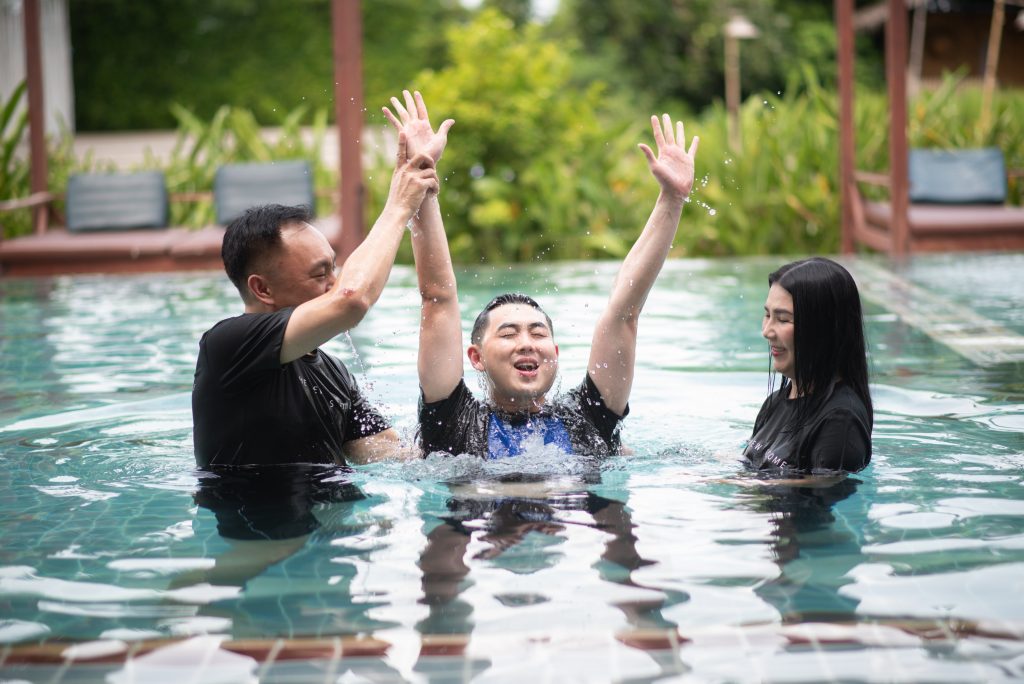
I was visiting a country church, and a young woman shared that she’d “been looking forward to getting baptised for ages”. They sure breed them tough out there – in the city we only baptise people for a few seconds!

As Baptists, you’d think we would be bigger on baptism. Strangely it seems to have drifted into the background over recent decades. Was it somehow due to our emphasis on action, on faith lived out practically in mission and justice? Against the importance of eating with neighbours, listening to the marginalised and shopping ethically, did baptism get lumped into the category of empty religious rituals, potentially a hypocritical substitute for actual righteous living? “If you want to please God, feed the poor! Don’t prance about in water or fiddle around with bread and juice and singing and saying prayers.”

If that’s how we thought, silly us. It suits the spirit of the age to claim that Christian worship and social righteousness are opposites when in truth there is a massive correlation between the two. Far from baptism being an act of washing one’s hands of real-world responsibilities, it points to and empowers them. The act of baptism is tangible, it is bodily. It steps the new or young believer’s faith out of the realm of ideas and philosophy and into the physical and the actual. It’s like taking me, a war-history buff, and inducting me into the army as a soldier, fitting me out with a uniform, and enrolling me in basic training. Things just got real. Baptism is for those who realise Jesus’ kingdom is real, and their need to get real with him.

So it’s pleasing to see baptism rise again in recent months as a topic and practice of priority for Australian Baptists. We’re re-learning what’s been right in front of us: that lasting transformation for good is driven by and made possible by a real connection to the living God. The real experience of reconciliation to God, knowing forgiveness, security, identity, and empowerment by the Spirit – these are what will result in transformed households, neighbourhoods and nations. It is those who seek shortcuts to the kingdom without the King and justice without the Judge who are in greater danger of wasting time with empty words, token actions and performative hypocrisy.

So pointing people to Jesus and, crucially, giving them an accessible way into his army of peaceful conquerors – this is our deep privilege. It’s not a retreat into religiosity, it’s an advance towards true progress.

Crossover will be encouraging and resourcing churches to speak of and offer baptism more openly and more often. Some might say this is about empty symbolism – we see it as giving more people an opportunity to find life to the full – and to bring life to their world in turn.

Author: Andrew Turner is Director of Crossover for Australian Baptist Ministries. 

Crossover exists to Help Australian Baptists Share Jesus. Please support our Easter Offering in 2023.